
AI vs Human Book Editors: Which One Produces Better Results?
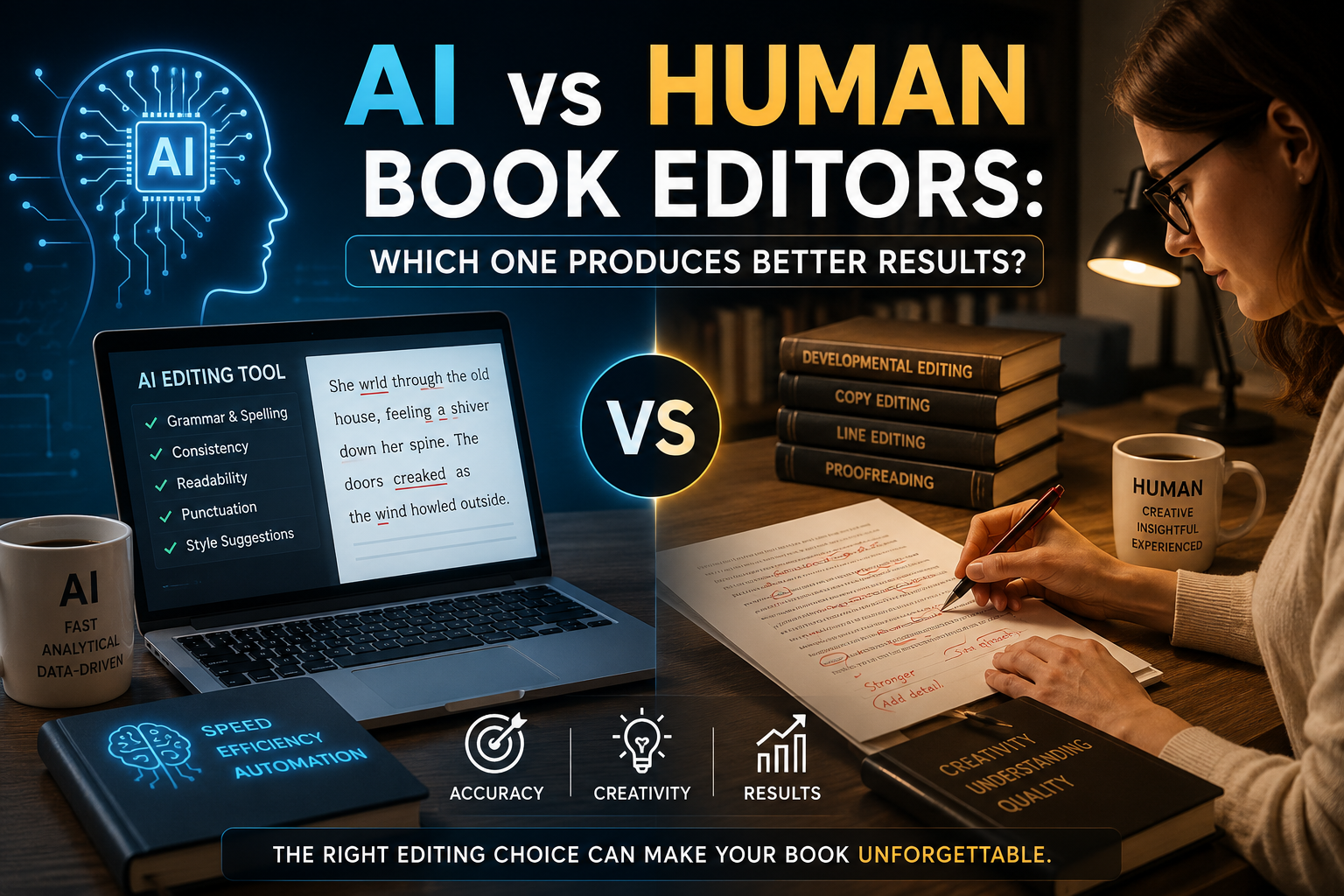
AI vs Human Book Editors: Which One Produces Better Results?

Every few years, a new panic sweeps through the publishing world. This one wears a silicon mask and answers to large language models. The question of the hour, AI vs human book editors, isn't just academic curiosity. Thousands of authors now stare at their draft and wonder if they can skip the middleman.
You can skip the middleman. What you cannot skip is the work. Whether that work is better done by a neural network or a professional with a red pen depends entirely on what you actually want from your final pages.
AI book editing vs human editing gets framed as an either-or choice. That binary ignores how each operates, where each fails, and the eerie reality that one of them doesn't actually read your book. It calculates it. There's a massive difference between being interpreted and being processed, and your manuscript will bleed for that distinction if you don't take it seriously.
The Editing Floor: A Side-by-Side Examination of AI Vs Human Book Editors
Understanding the output requires understanding the workflow. Imagine handing your manuscript to a seasoned professional. The kind you'd find if you hire a professional book editor with twenty years in the trenches. They read your opening chapter once for pleasure. They need to feel the story's pulse before they dissect it. A sentence strikes them as odd. They set the book down, brew coffee, and think about your protagonist's motivation.
Comma splices aren't the primary target when they return. They're looking for emotional justification. Did the anger in scene three feel earned? Was that plot twist telegraphed too early? These are qualitative, subjective judgments. They rely on lived human experience and a deep reading of genre tropes.
Now hand that same manuscript to an AI tool. The machine doesn't "feel" anything. It runs token probabilities. It notices "melancholy" appears twice in the first paragraph and suggests "sorrowful" for variety. It flags your intentional run-on sentence because its training data says grammatically correct sentences score higher in readability algorithms.
The AI has no idea you wrote that run-on to simulate a panic attack. It just knows the math doesn't align with the standard distribution of English syntax. Here's where those limitations of AI editing tools become glaringly obvious. These systems are correlation engines. They hunt for patterns. Comprehension isn't part of the equation.
Consider a piece of dialogue: "Oh, brilliant," she said, watching her car roll into the lake. A human editor reads that, smirks, and understands the dry wit perfectly. They might suggest a beat. Something like: She watched her car roll into the lake. "Oh, brilliant." That heightens the ironic pause. The AI flags "brilliant" as positive and the action as negative. It labels this a "tone inconsistency." It suggests replacing "brilliant" with "terrible."
Your joke just got murdered. The AI doesn't know it killed anything. It thinks it saved you from confusion. That's the core friction in the debate over whether is AI editing as good as human editing. The AI lacks basic human instincts. Sarcasm. Subtext. The ability to recognize when something works precisely because it shouldn't.
The Symmetry Trap: Why AI-Generated Edits Feel Like a Copy of a Copy
The most insidious danger of letting the algorithm run the show? The production of symmetrical, predictable patterns. Large language models love balance. They love parallel construction. They love turning jagged, unique writing into a smooth, featureless river rock.
When you ask a tool for heavy edits, it works to eliminate "awkwardness." But "awkward" is often where an author's voice lives. AI editing tools for authors frequently replace a unique, clunky phrase with a cleaner, more generic one. Do this across a hundred pages, and you don't get a clean manuscript. You get a homogenized slurry. Every character starts sounding like a corporate memo. Every descriptive passage adopts the same rhythmic cadence. The prose becomes symmetrical, predictable, and utterly forgettable.
Writers often wonder why their AI-edited draft feels "off" or "flat" even with perfect grammar. That's the reason. The AI sanded down the fingerprints. It removed the idiosyncratic flourishes that made the work yours and replaced them with the statistically average choice. Rely solely on book editing software vs human editor dynamics, and you're asking the machine to make your book look like every other book it has ever seen.
Originality becomes the casualty of statistical normalization. You aren't writing anymore. You're regurgitating the mean average of language.
The Untouchable Layers: Context, Culture, and Emotional Depth
A human editor brings context to the table that no dataset can replicate. They understand that a reference to "the wrong side of the tracks" means something different in rural Alabama than in inner-city London. They recognize cultural idioms, generational slang, and the subtle weight of historical allusion. When you hire a professional book editor, you pay for their library of lived experiences, their memory of other books they've edited, and their intuition about what a specific readership expects.
Machines only analyze patterns. They don't "recognize" culture. They map co-occurrences of words. This leads to disastrous results in culturally specific dialogue or character development. A human editor knows when to bend the rules for artistic effect. They know a sentence ending with a preposition isn't a crime. It's a stylistic choice. They know fragments can add punch. They know over-explaining ruins a mystery.
The limitations of AI editing tools in this realm are absolute. No interpretation. Only measurement against a norm.
The editorial relationship itself is also a form of craftsmanship. When authors work with a professional, they engage in a dialogue. They argue about a character's fate. They defend a chapter's length. This friction creates better books. A machine offers no resistance, only suggestions. It provides no reassurance during the grueling revision process. It doesn't look at a depressed author and say, "This is good, keep going." That human connection, the mentorship and encouragement, is a feature of book editing service providers that code can never emulate.
Beyond the "AI" Hype: The Evolution of Editing Algorithms
Let's ground this in reality. Writers have used digital editing aids for decades. Microsoft Word included spell check in the late 1980s. Grammarly arrived in 2009, offering rule-based heuristic suggestions. Deterministic systems. You made a subject-verb agreement error; they caught it. You used passive voice; they suggested active.
Modern AI is an evolution, not a revolution. Probabilistic models rather than rigid rules. A more robust algorithm running on larger data. The underlying premise remains the same. Pattern recognition. We must stop treating Large Language Models as sentient readers. They are hyper-advanced spellcheckers with a thesaurus and a trend analysis tool built in.
They catch inconsistencies in character hair color across chapters because they mathematically compare tokens. But they can't tell you the subplot about inheritance drags down pacing. They don't feel the drag. They don't get bored. They don't get excited. They don't care.
This historical context demystifies the hype. How does AI book editing work? It applies a statistical map of human language to your text. Incredibly efficient at tedious, mechanical tasks. But it isn't thinking. It certainly isn't creating. Recognizing this allows authors to stop asking "Can AI replace human book editors?" and start asking "Where does this tool fit into my workflow?"
The Hybrid Imperative: Prompt Engineering and Professional Oversight
The most intelligent approach currently employed by top-tier services, including our book editing packages, is hybrid. AI performs the initial triage. Humans handle the surgery. But even this process requires a sophisticated understanding of how to engage the AI.
Poor Approach: Dump the entire manuscript into an AI with "Edit this for me." The output is a mess. Contradictory suggestions. Over-corrected grammar. Flattened tone. You lose your voice in probabilistic noise.
Healthy Approach: Use the AI as a specialized utility. Feed it discrete, mechanical queries. "Identify all instances of the character's name spelled incorrectly." "Highlight every use of 'suddenly' so I can review them." "Generate a list of sentences longer than 30 words." These are surgical strikes. The AI handles them brilliantly.
The best book editing option for authors involves strategic deployment. Use the AI's processing power where it excels. Keep the human editor's interpretative authority where it matters. At Ghost Book Writers, we design this workflow meticulously. The author submits the draft. Our proprietary AI scans for surface-level errors, redundancy, and basic fact-checking against the text.
Then we make a human editor vs AI for authors decision at the deep structural level. We analyze the architecture of the narrative, the authenticity of the dialogue, and the emotional resonance of the climax. Finally, a manual proofread ensures no algorithmic overcorrection slips through. This balance lets us leverage speed without sacrificing the soul of the book.
Decoding the Dilemma: Speed vs. Soul
Let's break down the specific goals. When to accelerate. When to obsess.
Three clear goals where AI accelerates the process unequivocally:
Mechanical Consistency: Catching repeated typos, punctuation errors, and inconsistent formatting. AI never tires of scanning for Oxford commas. Infinite patience for drudgery.
Continuity Tracking: Exceptionally good at flagging if a character's eye color changes from blue to green or a timeline contradicts itself. It sees the matrix of facts.
Basic Redundancy: Quickly identifies when you've used a specific jargon term or power word twelve times in one chapter. Allows efficient lexicon variation.
Conversely, three core goals where human intervention is non-negotiable:
Emotional Pacing: Only a human editor can feel if a scene is too rushed or an emotional payoff falls flat. The AI has no gut.
Dialogue Authenticity: Humans know how humans speak. AI writes grammatically correct dialogue that sounds unnatural. No interruptions. No slang. No regional dialect. It sounds like a robot doing an impression of a person.
Thematic Resonance: Connecting the dots between the title, the narrative, and the overarching message requires philosophical comprehension. Machines match patterns. They don't grasp meaning.
The danger comes when these goals overlap. Ask the AI to fix "awkward dialogue." It "fixes" regional slang. Characters suddenly sound uniformly educated and formal. Authenticity dies. Similarly, if a human editor obsesses over mechanical fixes the AI could handle, they burn budget and time needed for developmental depth. The pros and cons of AI book editors are entirely context-dependent.
The cost comparison AI vs human editing looks favorable for AI on the surface. But the cost of bad editing is infinitely higher. Lost reviews. Poor sales. Damaged author reputation. Those scars don't heal.
AI vs Human Book Editors: Why Professional Human Editing Still Wins the Long Game
Which produces better results? If "better" means grammatically passable and fast, AI wins. If "better" means compelling, nuanced, and commercially viable, the human editor wins by a mile. The machine gives you a draft that won't embarrass you on a technical level. The human gives you a draft that will captivate a reader.
You cannot algorithmically engineer empathy. You can't program a gut feeling about a plot twist. You can't code a sense of humor.
AI vs human book editors work best as a partnership. The writers who thrive aren't the ones who reject technology. They also aren't the ones who naively embrace it as a substitute for craft. They use the tool to handle drudgery, allowing them and their professional human editor to focus entirely on the art.
When you decide to hire a professional book editor, you buy judgment, taste, and emotional intelligence. Finite, valuable resources. AI should protect that resource, not replace it.
For authors seeking the clear-headed path forward, look for book editing service providers with transparent workflows. If they claim to use only AI, run. If they refuse technology altogether, they're likely too slow or too expensive. The sweet spot acknowledges the limitations of AI editing tools and compensates with rigorous human oversight.
Whether weighing the AI book editing vs human editing cost spreadsheet or ensuring your literary baby doesn't get butchered, remember this: a book is a piece of your mind. Don't trust it to software that doesn't have a mind to begin with.
Frequently Asked Questions (FAQs)
Can AI completely replace a human book editor?
No chance. AI handles tasks, not judgment. Emotional intelligence, cultural context, creative intuition. Human domains. Machines process patterns. They don't understand belief. Your manuscript needs a collaborator, not a calculator.
Is AI editing cheaper than hiring a human editor?
Upfront, yes. But saving pennies today can cost you readers tomorrow. If AI flattens your voice, you lose more in royalties than you saved. Smart authors use AI for a first pass and spend their real budget on deep human development work.
Do literary agents or publishers accept AI-edited manuscripts?
They accept quality, not methods. If AI only catches typos, nobody cares. But if it rewrites your prose until it sounds generic, they'll reject it. Publishers want distinctive voices. The manuscript must still sound like you, not like a robot.
How much does professional human book editing cost compared to AI tools?
Professional editing ranges from cents per word to thousands for full developmental work. AI tools cost a monthly subscription. But you're not paying for time with a human. You're paying for specific genre knowledge and the ability to solve your book's unique problems. Serious authors invest in expertise.